
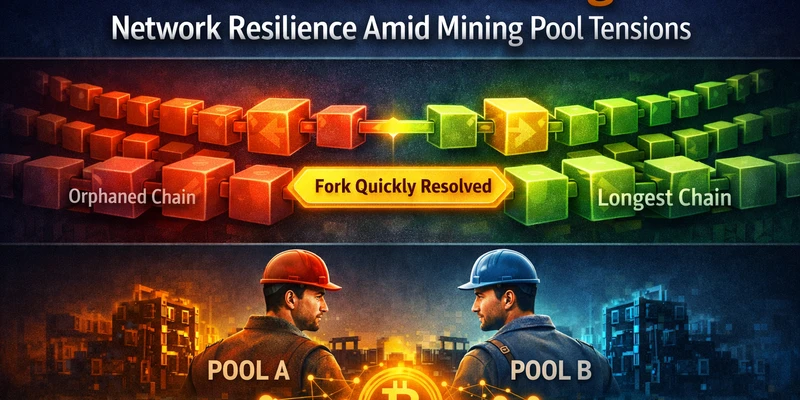
Bitcoin recently experienced a rare two-block reorganization, an event that briefly replaced previously confirmed blocks after competing mining pools produced conflicting versions of the chain. While such occurrences can sound alarming, the network handled it exactly as designed, quickly converging on the longest valid chain with minimal disruption.
The reorg reportedly involved major mining pools competing to extend the blockchain, with one chain ultimately overtaking another due to greater accumulated proof-of-work. Events like this are a natural byproduct of Bitcoin’s probabilistic finality, where temporary forks can emerge before consensus is re-established.
Although two-block reorgs are uncommon, they are not unprecedented. They typically occur when blocks are mined in close succession, creating short-lived disagreements between nodes about the canonical chain. In this case, the network resolved the conflict quickly, and no significant user impact was reported.
What makes this event noteworthy is the broader context: Bitcoin mining power has become increasingly concentrated among a handful of large pools. At times, just a few entities control a significant share of global hash rate, raising ongoing concerns about centralization and theoretical attack vectors.
Still, the takeaway remains clear. Bitcoin’s core protocol continues to function as intended. Even under competitive pressure between dominant miners, the system’s incentives and consensus rules ensure that disputes are resolved automatically, reinforcing the network’s overall robustness.
For DAPNet builders and observers, the lesson is straightforward. Decentralization is not the absence of conflict, it is the ability of a system to absorb it without breaking.