
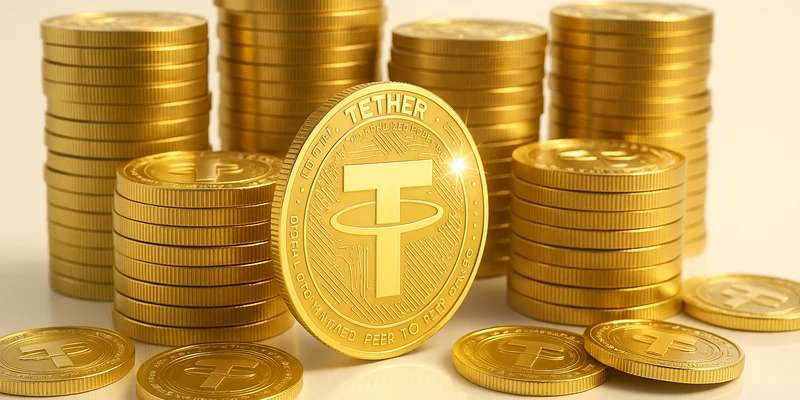
Tether is expanding its footprint in the real-world asset (RWA) narrative by deploying its gold-backed token, XAUT, on BNB Chain — pushing tokenized commodities deeper into the multi-chain ecosystem.
Each XAUT token represents one troy ounce of physical gold held in Swiss vaults, effectively turning a traditionally illiquid, off-chain asset into something transferable, divisible, and programmable. With this move, Tether is positioning gold not just as a hedge, but as a composable on-chain primitive.
At a surface level, the benefits are clear. Bringing XAUT to BNB Chain unlocks access to a large and active user base, reduces friction for traders, and integrates gold into DeFi environments where it can be used in lending, collateralization, and trading strategies. It also strengthens the broader RWA trend, where tangible assets are increasingly being mirrored on-chain to improve accessibility and efficiency.
But from a decentralization-first perspective, this expansion raises deeper questions.
While XAUT is tokenized, the underlying asset remains fully custodial and permissioned. The gold sits in centralized vaults, controlled by a single issuer, and users ultimately rely on Tether’s claims of backing and redeemability. This introduces a critical contradiction: the asset is traded in decentralized environments, yet its foundation is rooted in trust-based infrastructure.
This highlights a growing tension in crypto’s evolution.
On one hand, tokenized RWAs like XAUT represent a bridge between traditional finance and DeFi — bringing stability, real-world value, and broader adoption. On the other hand, they risk reintroducing the very intermediaries and opaque systems that decentralization aims to remove.
The deployment on BNB Chain further complicates the picture. While it offers scalability and liquidity, it is often viewed as a more centralized blockchain environment, governed by a limited validator set. Pairing a custodial asset with a semi-centralized network may improve efficiency, but it also concentrates control at multiple layers.
That said, the significance of this move shouldn’t be dismissed.
Tokenized gold has long been one of the most intuitive RWA use cases, and expanding it across chains increases its utility and visibility. For many users — especially those in unstable economic regions — access to gold via blockchain can be meaningfully empowering, even if it isn’t fully decentralized.
In that sense, XAUT on BNB Chain reflects a broader reality:
The path to decentralization may not be purely decentralized.
Instead, the current phase of the market appears to be hybrid — combining centralized asset backing with decentralized rails. The key question going forward is whether these systems evolve toward greater transparency and trust minimization, or whether they solidify into a new form of crypto-native centralization.
For now, Tether’s expansion is both progress and compromise — a reminder that bringing real-world value on-chain is as much a philosophical challenge as it is a technical one.